Swiss Sovereign Resilience Fund

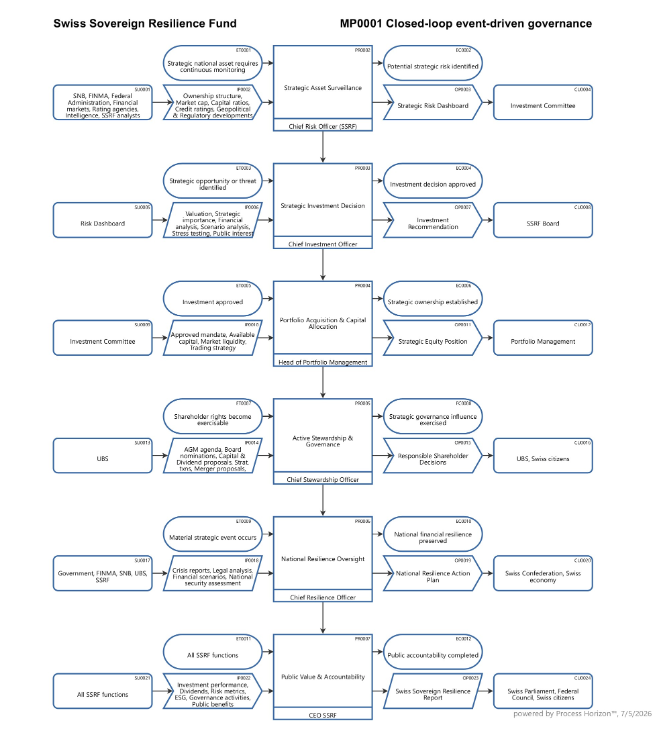
Here my proposal for a diversified sovereign wealth fund holding strategic Swiss & global assets, including a minority UBS anchor stake, with a mandate to protect long-term public value, financial stability & Swiss economic sovereignty.
Potential benefits of a Swiss minority stake in UBS via a Swiss Sovereign Resilience Fund (SSRF):
1. National financial sovereignty A minority stake would make Switzerland a visible anchor shareholder in its only remaining global systemically important bank. UBS Group AG is incorporated and domiciled in Switzerland, with its registered office in Zurich.
2. Protection against unfriendly takeover A sovereign stake could make a hostile or unfriendly takeover more difficult by creating a politically credible long-term shareholder. It would not fully block a takeover, but it would raise the strategic, legal and reputational cost for a bidder. In Swiss public takeover law, crossing the 33⅓% voting-right threshold generally triggers a mandatory offer obligation.
3. Protection against headquarters relocation A state-backed anchor stake could vote against or politically deter a relocation of UBS’s headquarters to a lower-regulation jurisdiction. This matters because regulatory pressure can create incentives for arbitrage if UBS sees Swiss rules as too restrictive.
4. Counterweight to regulatory arbitrage Switzerland is tightening too-big-to-fail rules after Credit Suisse, including higher capital expectations for UBS’s foreign participations. A sovereign fund stake would help ensure the response is not simply move away but remain Swiss, resilient & globally competitive.
5. Public participation in upside Swiss citizens already carry indirect downside exposure because UBS is systemically important. A sovereign stake would let the public share in dividends and capital gains, not only in crisis risk.
6. Compensation for implicit public guarantee Markets know Switzerland cannot easily allow UBS to fail disorderly. That implicit public backstop has value. A minority stake would partially convert that public guarantee into a public financial return.
7. Strategic shareholder voice The fund could vote on board elections, capital policy, dividends, mergers, acquisitions, restructuring and major governance issues without managing UBS operationally.
8. Stronger long-term orientation A sovereign fund can act with a multi-decade horizon. That would counterbalance short-term activist pressure focused on buybacks, excessive leverage or aggressive capital extraction.
9. Systemic-risk discipline The fund could use stewardship principles to support prudent capital, liquidity, risk culture, cyber resilience and resolvability.
10. Crisis preparedness A pre-existing stake creates institutional knowledge, ownership channels and governance routines before a crisis, instead of improvising during panic.
11. Better alignment between UBS & Switzerland UBS benefits from Swiss stability, law, infrastructure, human capital, reputation and monetary credibility. A public stake would make this mutual dependency more explicit.
12. Sovereign wealth creation The stake could become part of a broader Swiss Sovereign Resilience Fund holding diversified strategic assets, not just UBS. That would build national balance-sheet strength over generations.
13. Pension & intergenerational benefit Dividends & long-term capital gains could be allocated to AHV/AVS reserves, public debt reduction, innovation funding or future crisis buffers.
14. Signal of strategic commitment A minority stake would signal that Switzerland wants UBS to remain Swiss-based, globally competitive and responsibly governed.
15. Deterrence against excessive foreign influence Even if foreign investors hold large positions, a sovereign anchor shareholder gives Switzerland a permanent institutional voice.
16. Protection of Swiss employment & know-how UBS is not only a bank but a concentration of legal, compliance, wealth-management, technology and financial expertise. A sovereign stake could help preserve this strategic capability in Switzerland.
17. Protection of tax base Maintaining UBS’s Swiss domicile protects corporate taxes, high-value employment income taxes and related financial-sector activity.
18. Financial-centre credibility A professionally governed sovereign stake could reinforce Switzerland’s image as a stable, long-term financial centre rather than a jurisdiction that loses control of strategic institutions after crises.
19. Public accountability for systemic importance The fund could publish an annual stewardship and resilience report explaining how it voted, what risks it monitored and how public value was protected.
20. Reduced asymmetry between private profit & public risk Without public ownership, profits are private while systemic losses can become public. A minority stake partially corrects this imbalance.
21. Better governance transparency The stake could require systematic monitoring of ownership concentration, capital adequacy, relocation risk, takeover pressure and public-value contribution.
22. Soft golden-share effect without full nationalization Switzerland could gain influence without taking control. The fund would act as an anchor investor, not as a ministry running a bank.
23. Stronger negotiation position with UBS The state would not only regulate UBS from outside; it would also understand investor concerns from inside the shareholder structure.
24. Stabilization of market confidence A credible sovereign anchor shareholder could reassure markets during stress that Switzerland has a structured ownership and resilience framework.
Switzerland would convert systemic exposure into governed strategic ownership, so that public risk, public influence & public return will become aligned.
Using the following link you can access this sandbox SIPOC model in the ProcessHorizon web app and adapt it to your needs (easy customizing) and export or print the automagically created visual AllinOne SIPOC map as a PDF document or share it with your peers: https://app.processhorizon.com/enterprises/rPMSdiB27kzAcMwLizBSTxuE/frontend