Sovereign Data center ecosystem 2/2

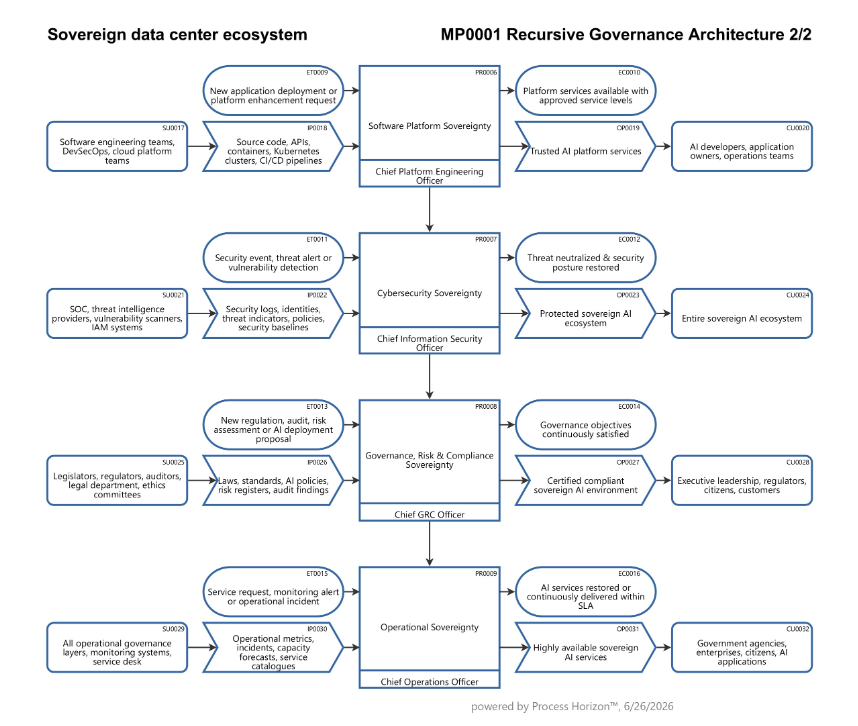
An AI-native sovereign data center can also be organized around specialized autonomous agents, each responsible for a major operational domain:
- Infrastructure Agent manages facilities, power, cooling & physical assets.
- Compute Agent orchestrates GPU, CPU, storage & workload scheduling.
- Data Agent governs data ingestion, quality, lineage, residency & access.
- AI Lifecycle Agent manages model development, validation, deployment & monitoring.
- Cybersecurity Agent detects threats, enforces Zero Trust & coordinates incident response.
- Operations Agent oversees AI Ops, capacity planning, service management & business continuity.
- Governance, Risk & Compliance (GRC) Agent enforces regulatory requirements, auditability & AI governance.
- Executive Dashboard Agent provides real-time observability, KPIs, risk indicators & decision support across the ecosystem.
Unlike a traditional data center, an AI sovereign data center must support the full AI value chain while ensuring that critical assets (data, models, infrastructure, operations & governance) remain under trusted control.
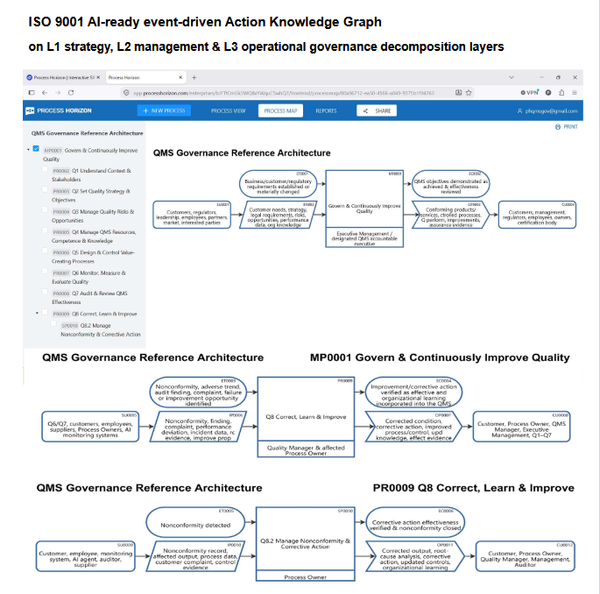
Using the following link you can access this sandbox SIPOC model in the ProcessHorizon web app and adapt it to your needs (easy customizing) and export or print the automagically created visual AllinOne SIPOC map as a PDF document or share it with your peers: https://app.processhorizon.com/enterprises/je6auWMkPERppFF4dKTq5XY5/frontend