AI-enabled modernization of the US ATC system

The modernization of the US Air Traffic Control (ATC) system presents an interesting opportunity for AI-driven infrastructure transformation, potentially involving Frontier AI companies, robotics providers and established aviation technology suppliers.
As the Trump administration is now requesting USD 50 billion in additional funding to modernize the system, what precisely must be purchased, what must be developed, what can be reused, and what can AI demonstrably deliver faster and cheaper without increasing aviation risk ?
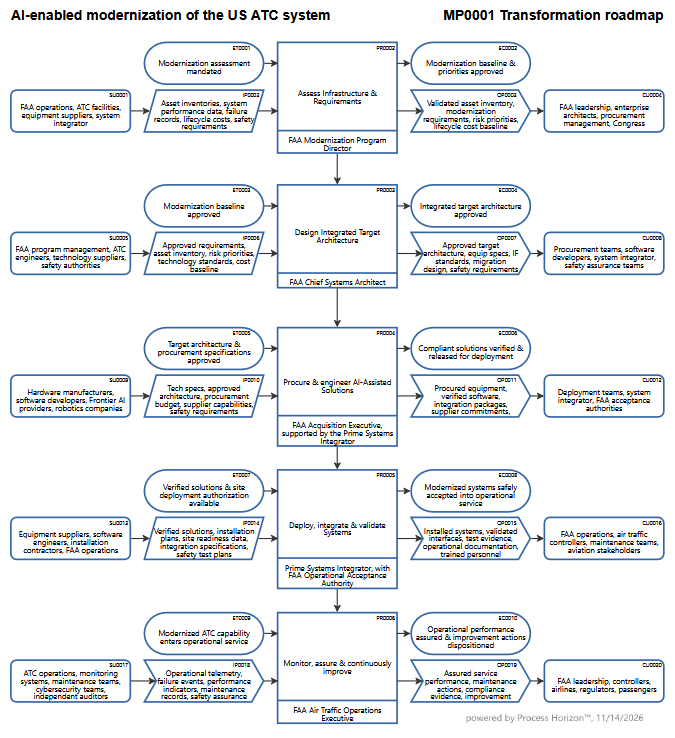
Event-driven AI-enabled transformation roadmap
P1 Assess Infrastructure & Requirements
Establish a reliable baseline of existing ATC infrastructure, modernization needs, risks, costs and implementation priorities.
P2 Design Integrated Target Architecture
Develop a standardized, interoperable and resilient ATC architecture that minimizes unnecessary complexity and lifecycle costs.
P3 Procure & engineer AI-assisted Solutions
Deliver interoperable hardware and verified software at optimal cost, quality and implementation speed.
P4 Deploy, integrate & validate Systems
Implement modernized ATC capabilities nationwide without compromising aviation safety or operational continuity.
P5 Monitor, assure & continuously improve
Sustain safe, resilient and cost-efficient ATC operations through proactive monitoring, independent assurance and continuous modernization.
StartEvent v Suppliers >Inputs >PROCESS >Outputs >Customers v EndEvent
From an event-driven action architecture perspective, the desired outcome should not simply be modernized technology. It should be safe, resilient & continuously available national air traffic management.
Using the following link you can access this sandbox model in the ProcessHorizon web app and adapt it to your needs (easy customizing) and export or print the automagically created visual AllinOne event-driven SIPOC map as a PDF document or share it with your peers: https://app.processhorizon.com/enterprises/EfkqHgvDgoWL81ToyqcMRP9p/frontend