Quantum String Theory explained by the event-driven SIPOC causal model

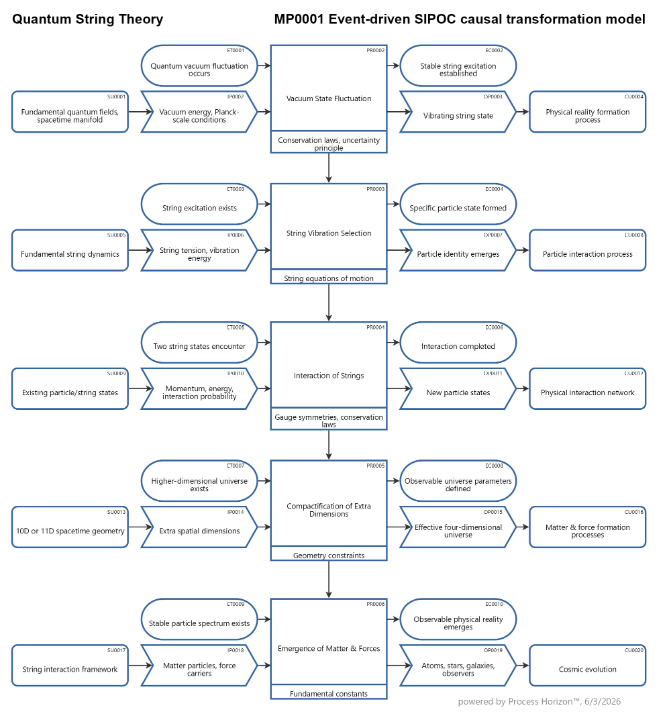
The event-driven causal SIPOC transformation model can describe how fundamental strings evolve and generate observable physical reality.
1. Vacuum fluctuation excites fundamental string
Describe how quantum fluctuations generate string excitations. Observation Points: Energy density, fluctuation spectrum
2. String vibrates in allowed modes
Determine particle properties from vibration modes. Observation Points: Mass, charge, spin
3. Strings split, join or exchange modes
Generate forces and particle interactions. Observation Points: Scattering amplitudes
4. Dimensions compactify into microscopic structures
Generate the physical laws observed in our universe. Observation Points: Coupling constants, particle spectrum
5. Continuous interaction and organization
Create the physical universe. Observation Points: Structure formation indicators
This framing turns String Theory from a purely mathematical model into a causal transformation architecture, making it compatible with the same event-driven SIPOC paradigm used for AI systems, banking systems, governance systems and even quantum mechanics.
In this view, String Theory becomes a hypothesis about the deepest "process layer" of reality: Suppliers: Fundamental strings Inputs: Current string state (energy, information, geometry) Process: Vibration & interaction dynamics Outputs: New particle/force state Customers: Subsequent universe state > the observable universe
The process transforms one quantum configuration into another.
The same architecture works for quantum physics, chemistry, biology, economics, organizations & AI agents.
Using the following link you can access this sandbox SIPOC model in the ProcessHorizon web app and adapt it to your needs (easy customizing) and export or print the automagically created visual AllinOne SIPOC map as a PDF document or share it with your peers: https://app.processhorizon.com/enterprises/WSru9As4Wg3FZaAWGgm4QC4E/frontend