Collaborative human-AI learning process model

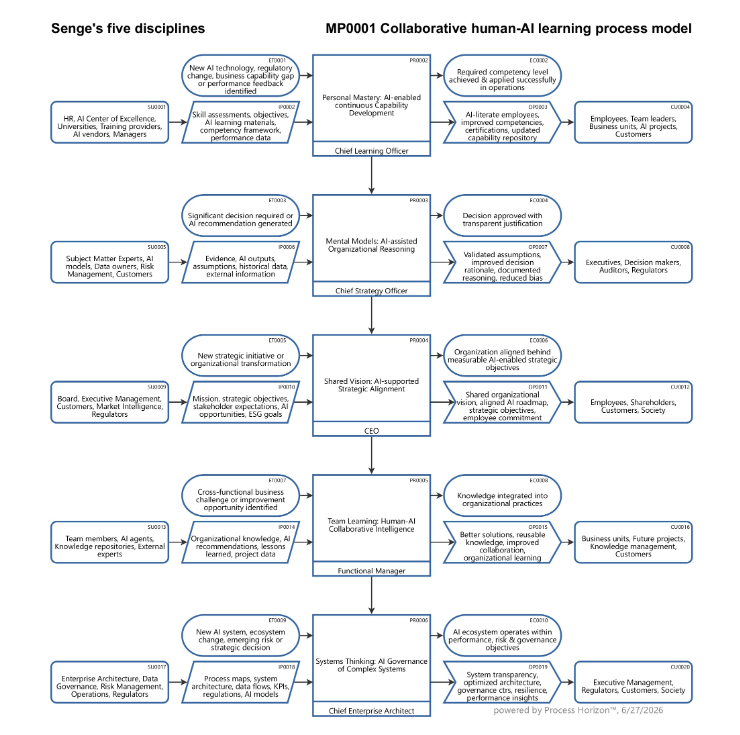
Peter Senge's five disciplines define the behavioral architecture of a learning organization. An event-driven SIPOC model defines its operational architecture.
1. Personal Mastery
AI augmentation by AI copilots to personalize learning, generate simulations, recommend courses, evaluate progress & coach employees continuously.
2. Mental Models
AI assists by generating alternative viewpoints, detecting inconsistencies, identifying hidden assumptions & simulating scenarios while humans remain accountable.
3. Shared Vision
Generative AI can summarize strategy, personalize communication, analyze stakeholder feedback & measure organizational alignment.
4. Team Learning
AI agents summarize meetings, retrieve knowledge, recommend experts, identify duplicate work & propose improvements.
5. Systems Thinking
AI continuously monitors ecosystems, detects anomalies, predicts failures, recommends optimizations & performs digital twin simulations.
Senge originally described the five disciplines as the foundations of a learning organization. In the age of AI, they can be viewed as five core governance processes that continuously improve an organization's capability to learn, decide, collaborate, align & adapt.
Using the following link you can access this sandbox SIPOC model in the ProcessHorizon web app and adapt it to your needs (easy customizing) and export or print the automagically created visual AllinOne SIPOC map as a PDF document or share it with your peers: https://app.processhorizon.com/enterprises/ar9seGEz6NRoxmTogtAeqLrW/frontend