AI-ready Enterprise Process Modeling evaluation

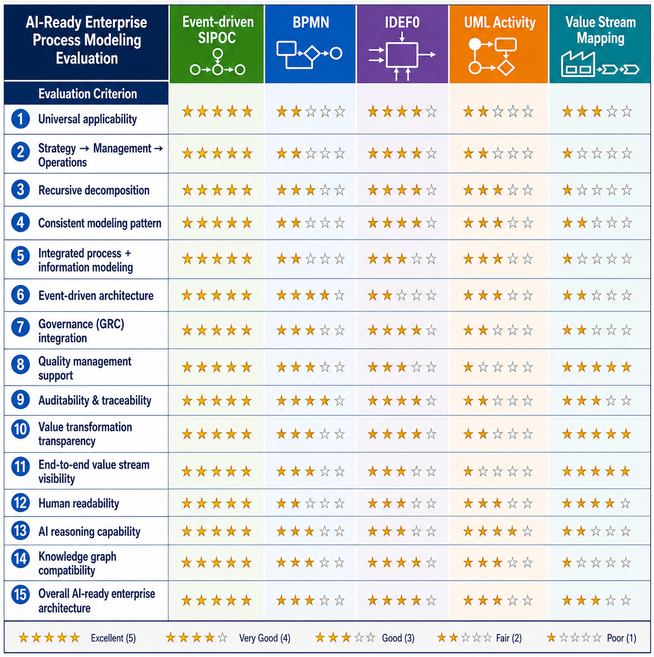
The purpose of enterprise process modeling is not merely to automate work but to make the enterprise understandable, governable, auditable, improvable & ultimately executable by both humans & AI.
From that perspective, the evaluation should emphasize qualities that remain valuable from the boardroom to autonomous AI agents.
Why Event-driven SIPOC excels:
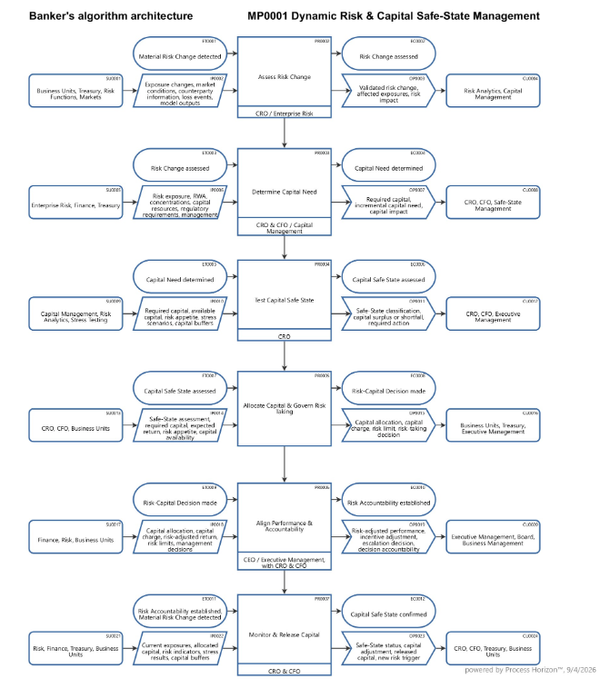
StartEvent > Suppliers > Inputs > PROCESS > Outputs > Customers > EndEvent
1. Universal applicability A single modeling language can describe strategic initiatives, governance processes, management systems, operational workflows, AI agents & even external ecosystems.
Caveat for others: Most alternatives were designed for a narrower purpose (workflow execution, software design, manufacturing optimization or functional analysis).
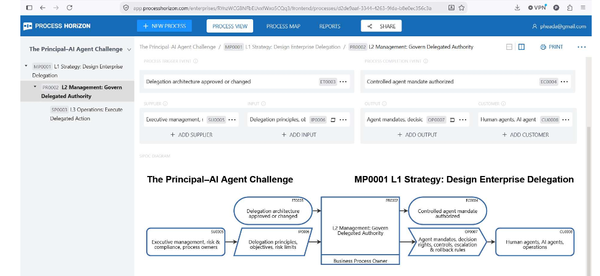
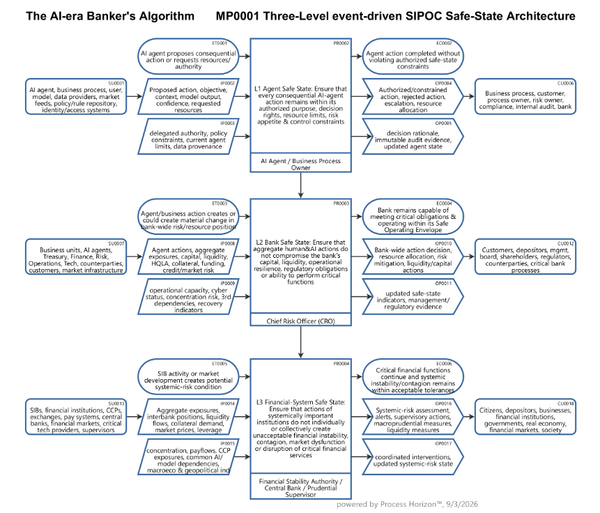
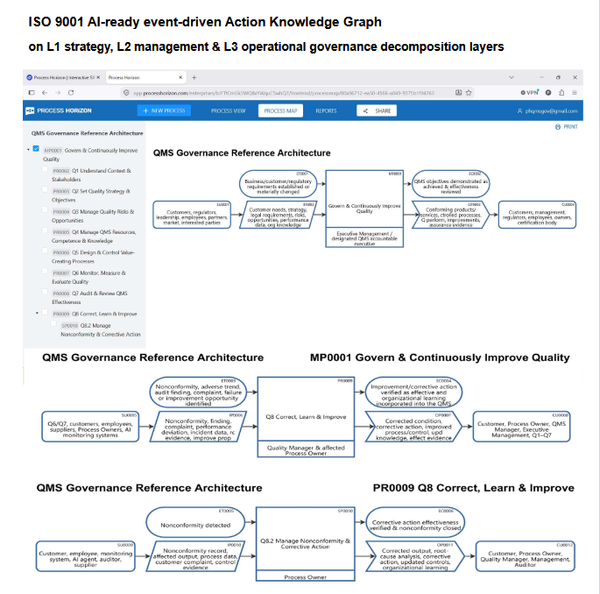
2. Layered architecture from Strategy to Management to Operations The same semantic structure applies consistently across all organizational levels, creating continuity from board-level objectives to operational execution.
3. Recursive decomposition Every process decomposes into child processes using the same event-driven SIPOC pattern, making navigation & reasoning straightforward for humans and AI.
4. Consistent modeling pattern One reusable template minimizes training effort and improves enterprise-wide consistency.
5. Integrated process & information modeling Suppliers, inputs, transformations, outputs, customers, controls, policies, risks & evidence are modeled together, reducing fragmentation.
6. Event-driven architecture Processes begin and end with explicit business events, naturally supporting event-driven systems, monitoring, and AI planning.
7. Governance, Risk & Compliance (GRC) Ownership, controls, risks, obligations & compliance evidence can be embedded directly within each process rather than maintained as disconnected artifacts.
8. Quality management support The structure aligns naturally with quality principles such as process ownership, customer focus, inputs, outputs, continuous improvement, and corrective action.
9. Auditability & traceability Every output can be traced back to its originating event, supplier, inputs, transformation logic, owner & controls, strengthening assurance & accountability.
10. Value transformation transparency The transformation step explicitly explains how value is created, making business logic visible rather than implied.
11. End-to-end value stream visibility Linked SIPOC processes reveal how value flows from origin to destination across organizational boundaries.
12. Human readability The limited set of core concepts makes models accessible to executives, domain experts, auditors, developers, regulators & operational teams.
13. AI reasoning capability AI agents naturally reason about events, inputs, outputs, dependencies, ownership, constraints & objectives. The event-driven SIPOC structure exposes these concepts directly.
14. Knowledge graph compatibility Each SIPOC object becomes a semantic node connected through explicit relationships, enabling enterprise knowledge graphs & retrieval-augmented AI.
15. Enterprise architecture for Agentic AI Event-driven SIPOC facilitated by the ProcessHorizon web app provides a common semantic all-in-one backbone that integrates process architecture, information architecture, governance, quality management, risk management & value creation. This supports not only documentation but also AI reasoning, planning, orchestration, monitoring & continuous improvement.
Existing methodologies remain highly effective within their original domains such as workflow automation, software behavior, functional analysis or Lean optimization but generally require complementary frameworks to achieve the same breadth of enterprise integration.
Event-driven SIPOC is a universally applicable action-modeling methodology that makes any goal-driven transformation transparent to any stakeholder using a minimal, consistent set of information objects.