AI-augmented skilled professionals

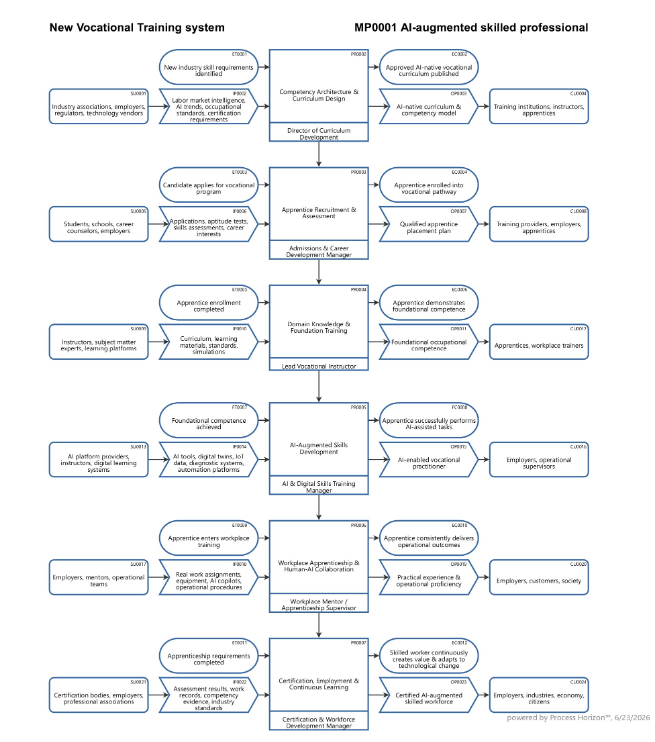
An AI-native vocational education & training system can be conceived as a lifecycle that transforms a student into an AI-augmented skilled professional capable of operating, supervising & improving increasingly automated systems.
1. Competency Architecture & Curriculum Design
Design competency framework combining domain expertise, AI literacy, digital skills, systems thinking & human judgment.
2. Apprentice Recruitment & Assessment
Evaluate candidate suitability, learning readiness & vocational pathway alignment.
3. Domain Knowledge & Foundation Training
Teach trade-specific theory, safety principles, regulations, engineering concepts, quality requirements.
4. AI-Augmented Skills Development
Train apprentices to leverage AI for planning, diagnostics, troubleshooting, quality assurance, predictive maintenance, decision support.
5. Workplace Apprenticeship & Human-AI Collaboration
Execute supervised work, collaborate with AI systems, apply professional judgment, solve real-world problems.
6. Certification, Employment & Continuous Learning
Certify skills, place graduates into employment, monitor performance, provide continuous upskilling on new AI technologies.
The six-process model shifts vocational education from training people to perform tasks toward training people to orchestrate intelligent systems.
From an event-driven SIPOC perspective, vocational training thus becomes a national capability for producing the human process owners required to operate the increasingly AI-native economy.
Using the following link you can access this sandbox SIPOC model in the ProcessHorizon web app and adapt it to your needs (easy customizing) and export or print the automagically created visual AllinOne SIPOC map as a PDF document or share it with your peers: https://app.processhorizon.com/enterprises/MVKYbZYaXsdE71RY78oouXio/frontend