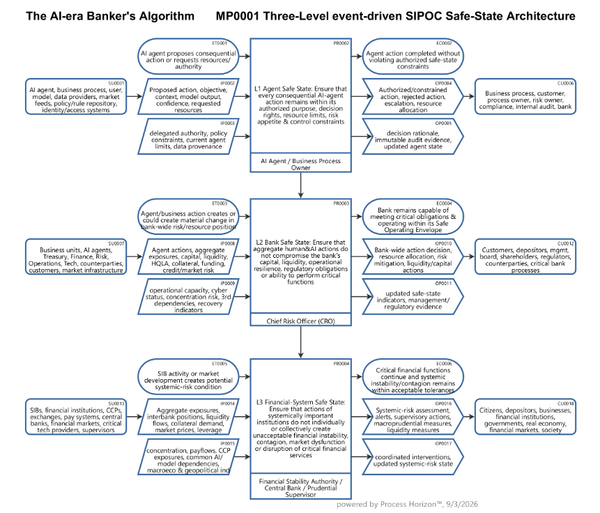
Dynamic Risk & Capital Safe-State Management

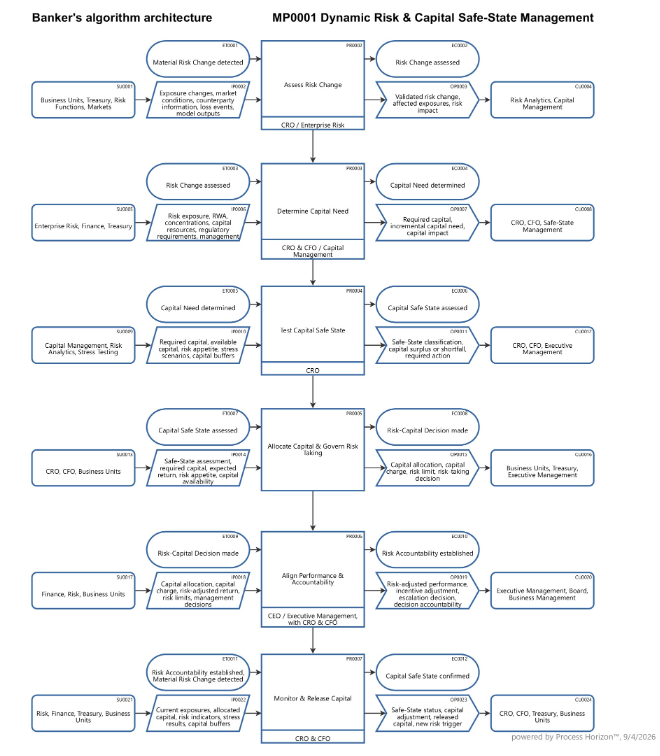
The important architectural shift with the banker's algorithm is to treat capital not as a largely fixed annual constraint that business units subsequently consume, but as a continuously recalculated scarce safety resource attached to risk-taking.
1. Assess Risk Change
Determine how a material change like a new transaction, market shock, AI-agent action or counterparty downgrade affects the bank's actual & prospective risk profile.
2. Determine Capital Need
Translate the changed risk profile into the capital required to absorb actual & prospective losses.
3. Test Capital Safe State
Determine whether sufficient loss-absorbing capacity remains available under current & stressed conditions after accepting the changed risk.
4. Allocate Capital & Govern Risk Taking
Allocate capital to economically justified risk-taking while constraining activities that would weaken the bank's Capital Safe State.
5. Align Performance & Accountability
Ensure that performance measurement, management incentives & decision accountability reflect the capital consequences of risk-taking.
6. Monitor & Release Capital
Maintain the Capital Safe State as risk changes & release capital only after the underlying risk reduction has been demonstrated.
Any subsequent material risk change restarts the loop.
The Governance objective is to continuously align the GSIB's loss-absorbing capital capacity with its actual & prospective risk-taking, increasing capital as risk increases & releasing capital only when the underlying risk demonstrably declines.
Using the following link you can access this sandbox model in the ProcessHorizon web app and adapt it to your needs (easy customizing) and export or print the automagically created visual AllinOne event-driven SIPOC map as a PDF document or share it with your peers: https://blog.processhorizon.com/ghost/#/editor/post/6a9a8d83593073038eda042c