Digital ID footprint comparison

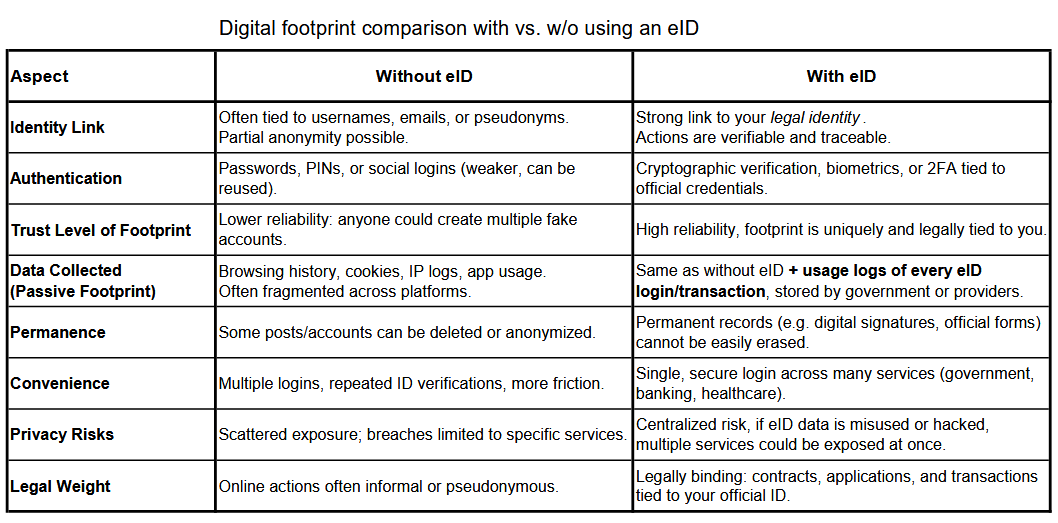
Here’s a clear side-by-side comparison of how your digital footprint differs with vs. without using an eID.
|
Aspect |
Without
eID |
With eID |
|
Identity
Link |
Often tied to usernames, emails, or pseudonyms. Partial anonymity possible. |
Strong link to your legal identity. Actions
are verifiable and traceable. |
|
Authentication |
Passwords, PINs, or social logins (weaker, can be
reused). |
Cryptographic verification, biometrics, or 2FA tied
to official credentials. |
|
Trust
Level of Footprint |
Lower reliability — anyone could create multiple
fake accounts. |
High reliability — footprint is uniquely and legally
tied to you. |
|
Data
Collected (Passive Footprint) |
Browsing history, cookies, IP logs, app usage. Often fragmented across platforms. |
Same as without eID + usage logs of every eID
login/transaction, stored by government or providers. |
|
Permanence |
Some posts/accounts can be deleted or anonymized. |
Permanent records (e.g., digital signatures,
official forms) cannot be easily erased. |
|
Convenience |
Multiple logins, repeated ID verifications, more
friction. |
Single, secure login across many services
(government, banking, healthcare). |
|
Privacy
Risks |
Scattered exposure; breaches limited to specific
services. |
Centralized risk — if eID data is misused or hacked,
multiple services could be exposed at once. |
|
Legal
Weight |
Online actions often informal or pseudonymous. |
Legally binding — contracts, applications, and
transactions tied to your official ID. |
Without eID
Your footprint is more fragmented, sometimes anonymous, but less secure.
With eID
Your footprint is more secure, unified & trustworthy, but also more permanent, traceable & concentrated.