Defense model for the Critical National Infrastructure

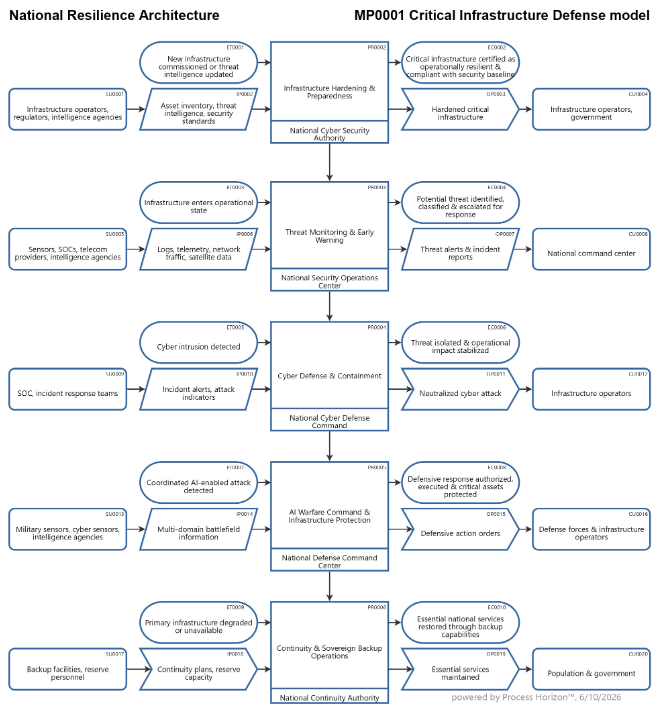
Future warfare is likely to become networked AI warfare: sensors, satellites, drones, cyber systems, command platforms & human commanders connected through AI decision layers.Warfare becomes a system-of-systems contest. The decisive resource is no longer only the fighter jet, tank, or missile. It is the closed-loop kill-chain & decision-chain architecture.
From a strategic perspective, one of the largest risks is not the destruction of individual weapons systems, but the loss of the supporting infrastructure that enables society & military operations to function.
A useful way to think about future warfare is as a dependency stack: 1. Energy (power generation & grid stability) 2. Communications (persistent connectivity) 3. Compute capacity (ability to process intelligence & coordinate operations) 4. Data (corrupted or unavailable data) 5. Decision-making 6. Military operations If a lower layer fails, all layers above it degrade.
Defense model
1 Infrastructure Hardening & Preparedness 2 Threat Monitoring & Early Warning 3 Cyber Defense & Containment 4 AI Warfare Command & Infrastructure Protection 5 Continuity & Sovereign Backup Operations 6 Recovery, Learning & Resilience Enhancement
The goal of this national resilience architecture is not military victory but continuity of society, government & essential services despite cyber & AI-enabled attacks. In a future networked conflict, resilience & recoverability may be more decisive than the number of weapons platforms deployed.
Using the following link you can access this sandbox SIPOC model in the ProcessHorizon web app and adapt it to your needs (easy customizing) and export or print the automagically created visual AllinOne SIPOC map as a PDF document or share it with your peers: https://app.processhorizon.com/enterprises/Ykb4A43wgKVuXU7Zh3jpAmgP/frontend