Audit trail for event-driven transaction data lifecycle

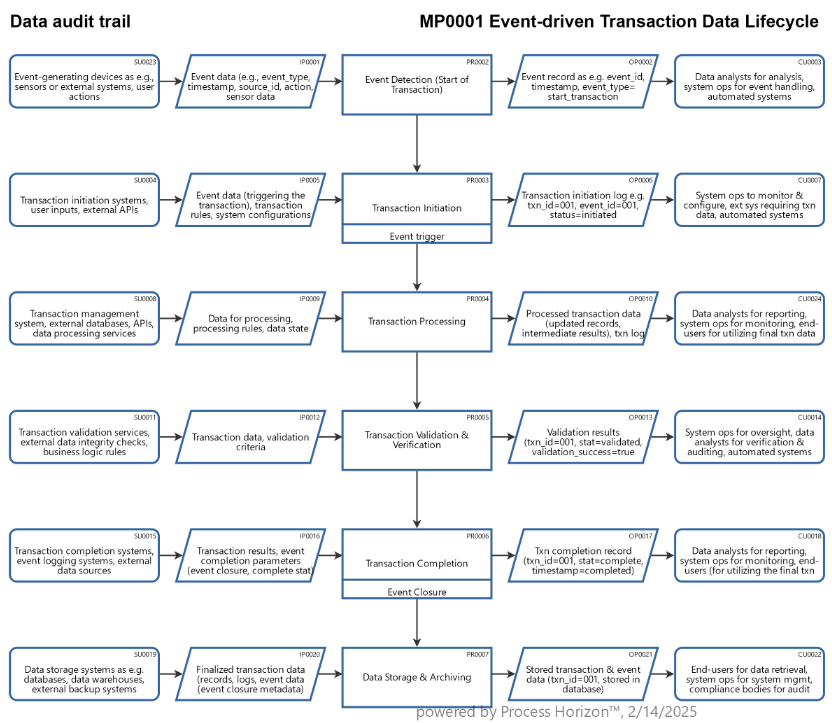
This SIPOC process model outlines each step of the Transaction Data Lifecycle with events as the start and end datapoints.
The lifecycle begins when an event triggers the initiation of a transaction and ends when the event-related transaction data is processed, stored, and finalized.
The transaction data lifecycle can be thought of as a series of steps that involve both event-driven actions and transaction processing stages. These steps will include event detection, transaction initiation, transaction processing, transaction completion and event closure with events marking the start and end of each data transaction.
It ensures that every event, from detection to closure, is appropriately handled, processed, validated, and stored, while highlighting the key roles of each stakeholder (suppliers, customers) in the process. By following this model, data traceability, integrity and security can be effectively maintained across the entire transaction lifecycle.
Using the following link you can access this sandbox SIPOC data & process model in the ProcessHorizon web app and adapt it to your needs (easy customizing) and export or print the automagically created visual AllinOne process map as a PDF document or share it with your peers: https://app.processhorizon.com/enterprises/32VQA3LPsa9rSTJKpgYkQbWk/frontend