
How to design an API for AI agents ?

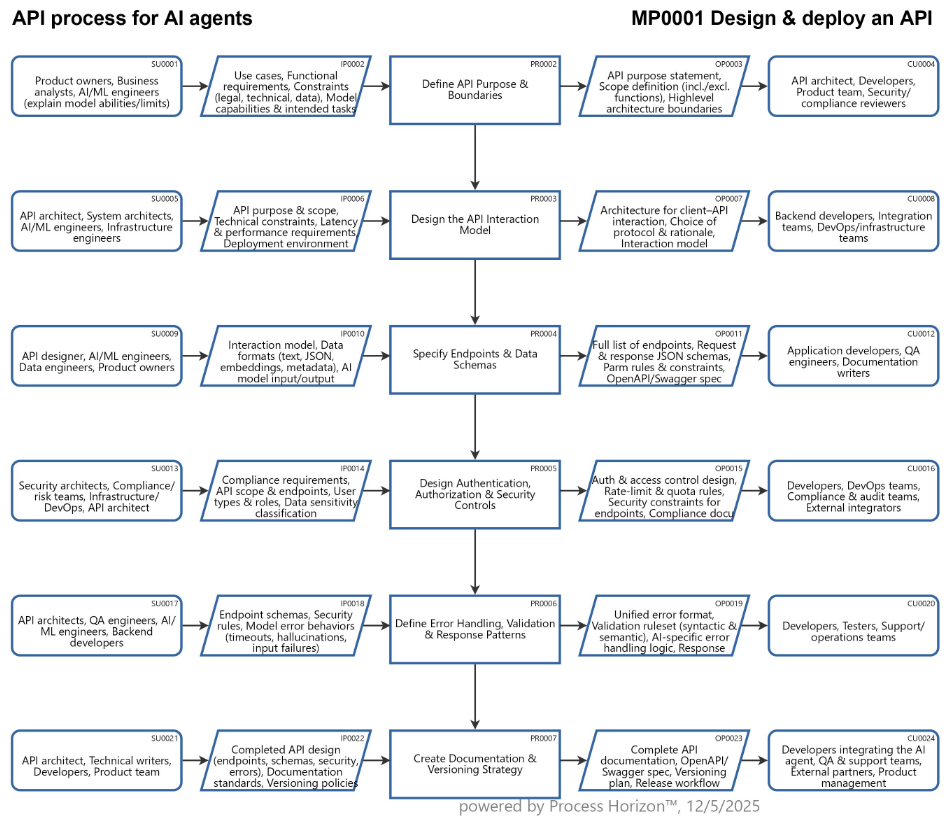
A SIPOC model is vital to the design and deployment of an API for an AI agent solution because it brings structured transparency, alignment & control to a process that involves multiple stakeholders, high technical complexity and significant governance & compliance considerations.
1. SIPOC ensures full transparency across all stakeholders
An AI agent API touches many groups like product, engineering, ML, security, compliance, operations, and external partners.
The SIPOC modeling methodology clearly describes:
- Suppliers: who provides requirements, data, constraints
- Inputs: what must be considered (models, privacy requirements, schemas, risks)
- Processes: the steps taken (e.g. endpoint design, security hardening)
- Outputs: what is produced (documentation, governance artifacts)
- Customers: who consumes & depends on the API
This shared view eliminates blind spots and prevents misalignment, especially in complex AI ecosystems.
2. It helps enforce governance, oversight & auditability
AI APIs need strict governance due to:
- Data sensitivity
- Model risks (bias, misuse, hallucination)
- Regulatory pressure (GDPR, AI Act, industry-specific rules)
- Access control and model invocation monitoring
A SIPOC model:
- Documents who is responsible for what, making accountability explicit
- Creates a traceable record of inputs & decisions, essential for auditing
- Ensures governance controls are planned during design, not retrofitted later
This is essential for regulatory compliance & internal risk management.
3. It addresses AI-specific risks early & explicitly
AI APIs have unique risk factors compared to traditional APIs:
- Unpredictable model outputs
- Data leakage via prompts or responses
- Bias or toxic output
- Misalignment with business or regulatory requirements
- Model drift and changes in behavior over time
SIPOC forces teams to consider:
- Risk-relevant inputs (model limitations, security needs, policies)
- Risk-mitigation steps in the process (validation, safety layers, rate limiting)
- Outputs documenting risk decisions
- Stakeholders responsible for risk monitoring
This ensures the API is designed with AI safety in mind, not as an afterthought.
4. It strengthens quality by standardizing the design process
An AI agent API must meet high standards of:
- Reliability
- Predictability
- Data & schema consistency
- Error handling clarity
- Performance and latency
SIPOC helps ensure quality by:
- Defining required inputs such as testing standards, model evaluation metrics & schema validations
- Mapping these inputs to a clear process (API design, validation, testing, documentation)
- Establishing expected outputs such as test plans, validation rules and error frameworks
This reduces variability and increases repeatability.
5. It supports compliance with AI governance frameworks
Regulatory & industry standards expect:
- Documented design phases
- Transparency of model inputs & outputs
- Traceability of lifecycle stages
- Clear roles & responsibilities
- Defined customer impact
SIPOC naturally produces the type of structured documentation required by:
- EU AI Act
- ISO/IEC 42001 (AI Management Systems)
- NIST AI Risk Management Framework
- Internal enterprise governance bodies
Thus, it becomes part of the organization’s compliance evidence.
6. It bridges business, technical, and compliance perspectives
Without a structured method, API design often becomes overly technical.
SIPOC:
- Uses language accessible to all stakeholders
- Captures business intent, technical design & governance needs in the same model
- Facilitates cross-disciplinary signoff
- Prevents gaps between business objectives & AI capabilities
This ensures the API is both fit for purpose and safe to deploy.
7. It prevents costly rework during deployment and scaling
Because SIPOC clarifies:
- What the API must do
- What is out of scope
- Who is responsible
- Which dependencies exist
- Which risks must be managed
Teams avoid:
- Misbuilt endpoints
- Missing security controls
- Compliance blockers discovered too late
- Architecture that doesn’t scale with model complexity
This protects both time and budget.
Using the following link you can access this sandbox SIPOC model in the ProcessHorizon web app and adapt it to your needs (easy customizing) and export or print the automagically created visual AllinOne SIPOC map as a PDF document or share it with your peers: https://app.processhorizon.com/enterprises/aUzAaAUefCvU5RUuE4RARksH/frontend